
Lelit Anna PL41TEM review


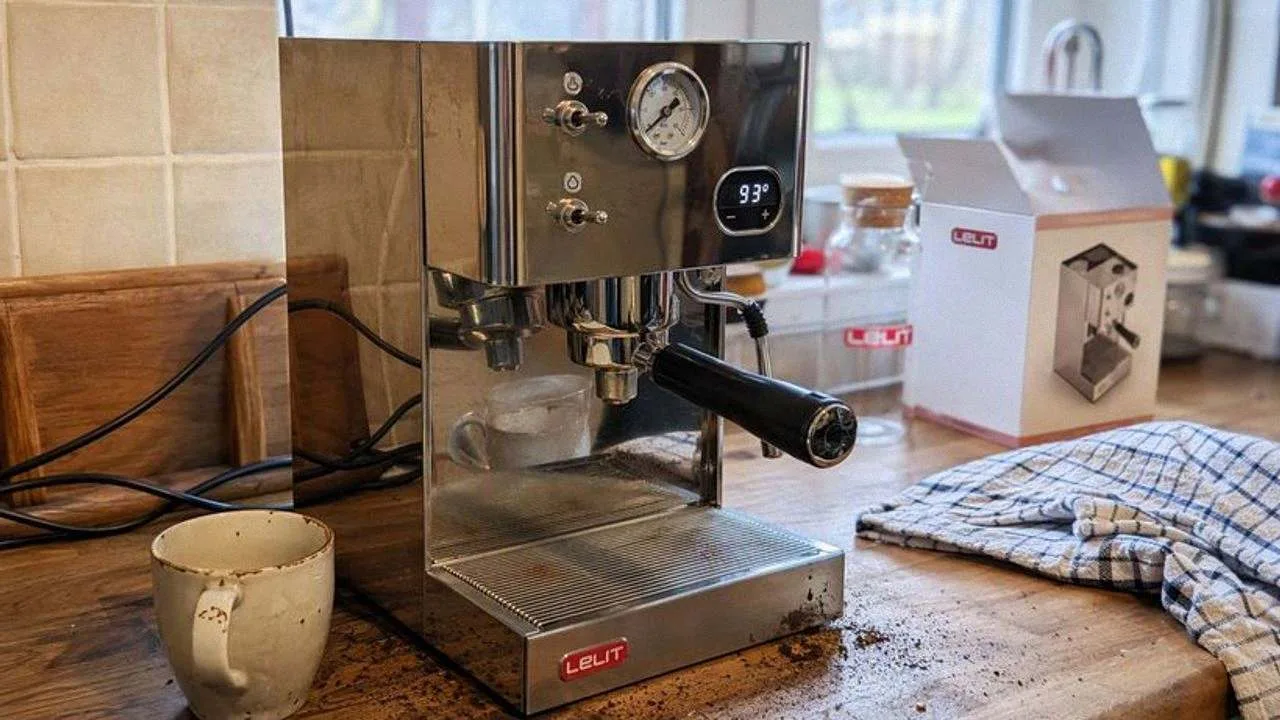
A factory PID at the entry to the prosumer tier, and a 57 mm group almost no third party kit fits. Which of those you notice depends on you.
VerdictWe put the Lelit Anna PL41TEM at 8.2, our lowest mark among the three prosumer machines here. It is the cheapest way to buy a factory PID, with brew temperature settable from 80 to 130 degrees in single steps, and it rates 4 for build and 4 for steam and milk. The catch is the 57 mm group: one millimetre off the standard, and most third party accessories will not fit it.
Main strengths
Key facts
Prosumer: café components in a domestic body. Serviceable for years, and it expects you to learn it.
In this article
- Why the little display on the front changes the coffee
- What pulling a shot on it actually involves
- Milk, and the minute you wait for it
- The 57 mm group, and the shelf it shuts you out of
- Where owners disagree: priming the boiler after steaming
- Which Anna is actually in the box
- The worktop: 23 cm across, 38 deep, 7.5 kg
- Is Lelit owned by Breville?
- Anna PL41TEM or Gaggia Classic Evo Pro?
- Who should buy one
- Ten years of it, and the parts that decide them
- FAQ: the group size, the wait and the grinder
The Lelit Anna PL41TEM sells you a temperature controller and charges for it in millimetres.
Our 8.2 is the lowest mark of the three prosumer machines in this catalogue, and this is also the one that does not hand you the brew temperature as homework. What that leaves you with is a different daily cost, and it is measured in time. Pull the shot, flip to steam, and stand at the worktop for the better part of a minute before the milk can start. On a Saturday nobody minds. The rest of this is about the mornings that are not Saturday, and about the millimetre.
Why the little display on the front changes the coffee
A PID turns up on 2 of the 14 specifications in our catalogue, and the other one arrives with a grinder bolted to it. That is the Sage Barista Express, a machine sold to people who wanted one box instead of two. Here the controller is the whole argument. Brew temperature runs from 80 to 130 degrees in single steps and steam from 120 to 140, both set on the display, as one British reviewer's spec sheet lays out.
A PID, meaning proportional integral derivative, is the small piece of electronics that learns when to switch the heating element off so the boiler stops overshooting its target. Take it away and you get a thermostat that swings past the target in both directions, which leaves you timing your shot to catch the middle of the swing. Home baristas call that temperature surfing, and the Gaggia Classic Evo Pro still asks for it every morning.
Read those bars next to its neighbours and the picture sharpens. Hands-on control sits at 85, level with both the Gaggia and the Rancilio Silvia, so nobody is claiming this machine is easier to learn. The difference is one bar. Temperature stability reads 80 here, and those two do not appear on the axis at all, because neither of them has anything inside doing the job.
What pulling a shot on it actually involves
Eighteen grams into the basket and somewhere near 32 to 36 grams in the cup, which is the ordinary modern recipe and not a Lelit quirk. Our dose and yield calculator will do that arithmetic once you have scales. What the Anna PL41TEM adds is a pressure gauge on the front telling you what the puck did while it happened.
The cheapest way into a PID and a brass boiler, which is the combination that stops you guessing at temperature. The 57 mm portafilter is the catch: almost no accessory in the shops fits it.
- Build & durability
- Steam & milk
- Ease of use
- Value
- Versatility
There is no shot button. One toggle chooses coffee, steam or water, a second toggle runs the pump, and you work them in that order every time, which takes about a morning to stop thinking about. Behind both sits a three way solenoid valve. It dumps the pressure the moment the shot ends, so the spent coffee comes out as a dry puck you knock into the bin rather than a slurry you rinse away.
The over pressure valve is adjustable once the lid is off, which matters more than it sounds. Most machines in this bracket arrive pushing harder than the 9 bar espresso actually wants, and on this one bringing that down is a screwdriver job rather than a parts order.
Milk, and the minute you wait for it
Steam and milk rate 4 out of 5 here, and the rating flatters the hardware slightly: our steam weighting is 70, where the Silvia carries 90 and the Gaggia 75. The reason sits in Lelit's own specification, a brass boiler of 250 ml. It will texture one jug properly and it will want a moment to gather itself before the next.
What you get back for the missing power is control. Because the steam temperature is adjustable, you can turn it down while you are learning and up once your hands know what they are doing. That same British review clocked 170 ml of milk to 60 degrees in 36 to 40 seconds with the boiler set to its 140 degree maximum, and around a minute at the gentler 125 setting.
Now the wait from the opening. One boiler does one job at a time, so the machine has to climb from brew heat to steam heat while you stand there, and the timings from that review put the climb at one minute to one minute thirty five depending on the setting you chose. Ten past eight on a Tuesday, with a school run attached, is where that lands hardest. It is why our record files this one under weekend rhythm.
The 57 mm group, and the shelf it shuts you out of
Three of our 14 machines take a 51 mm group, two take 54 mm, two take the 58 mm café standard, and exactly one takes 57 mm. That one is this machine, which turns the accessory question from an opinion into arithmetic. A size of one is a size nobody tools up for.
In practice the shortage lands on the small things people buy in year two: bottomless portafilters, the dosing funnels that stop grounds landing on the worktop, puck screens, spare baskets, tampers. You can find all of them, from a short list. Lelit stocks its own tools for the 57 mm group, and a British review of the machine reports that a Gaggia wooden handled tamper drops straight in, which is the sort of thing you learn from an owner and never from a listing.
Lelit's own page says as much without meaning to. It lists the group as LELIT57, compatible with LELIT57 barista tools, which is a company naming its accessory shelf after itself.
Where owners disagree: priming the boiler after steaming
In the r/espresso thread that first machine buyers keep landing on, 20 comments deep, two owners contradict each other flatly. One says it is extremely important to prime the boiler after steaming, meaning run water through to pull the temperature back down from steam heat. Another replies that two years of pulling two drinks and then steaming, three days a week, has produced no sign of anything wrong.
Both descriptions fit the same machine, and the order of operations is what separates them. Steam first and brew afterwards on any single boiler and the water sitting in there is far too hot for coffee, so the flush is not optional. Brew first and steam last, which is what most people do, and the machine cools on its own before the next shot.
Which Anna is actually in the box
Three machines wear this name and only one of them has the controller. The PL41TEM is the PID version, sold in some places as the Anna 2 or the Anna PID. The LEM drops the PID. The EM drops the PID and the pro steam wand, and swaps the toggles for buttons, according to that same UK breakdown of the versions.
This matters most second hand, where photographs of the three are close to identical and the listing title is often just Lelit Anna. Read the model code. If it does not say PL41TEM, the display you are buying the machine for is not fitted.
The worktop: 23 cm across, 38 deep, 7.5 kg
Lelit publishes 23 by 38 by 34 cm and 7.5 kilograms, and the depth is the figure to measure against, not the width. At 38 cm front to back this sits deeper than most kettles and takes up genuine worktop, while the 34 cm height means the tank lid needs clearance under a wall cupboard.
The same sheet gives a tank of 2.7 litres, which is a lot for a machine this size, and a cut out in the side panel lets you see the level. Two irritations come with it. The plastic is fairly opaque, so the window takes some peering, and there is no handle, so refilling the tank in place tends to end with your fingers in the water. Against that, the drip tray runs to over 800 ml, far more than this footprint suggests.
Is Lelit owned by Breville?
Breville Group has owned Lelit since 1 July 2022, per the company's own market filing, and the British version of that answer is the interesting one. In the UK that group sells its own machines under the Sage name, because the Breville trademark here belongs to an unrelated company.
So a British buyer choosing between this and a Sage is choosing between two brands with one owner, which changes nothing about the coffee and quite a lot about how you read the marketing. It also means the Bambino Plus and its automatic milk is a stablemate rather than a rival camp, aimed at the person who wanted the drink rather than the hobby.
Anna PL41TEM or Gaggia Classic Evo Pro?
Two numbers decide this one, and neither of them is the 72 per cent our similarity model gives the pair. The Gaggia holds the top value rating of 5 against the Anna's 4, and its serviceability weighting of 95 against this machine's 75. Buy the Gaggia and you are buying a platform to work on. Buy the Anna and you are buying the answer already fitted.
Fettlers buy the Gaggia, the Anna arrives finished
If you enjoy tinkering, the Gaggia is the better platform and the full value case for it sets out why; if you would rather the gauge, the controller and the adjustable valve came in the box, this is the machine. The Silvia is a third answer again, heavier, with the best wand of the three, and our verdict on that steam covers the ground where it wins.
Who should buy one
Buy the Lelit Anna PL41TEM if you want to learn espresso without also learning to time a thermostat, and a capable grinder is already in the budget. That is the machine's argument, and at 8.2 we think it holds. Nothing in this box grinds beans, and feeding this group from a supermarket burr set wastes most of what the machine can do.
Ten years of it, and the parts that decide them
This is the least openable of the three, and our record says so twice over: build and durability rate 4 where both rivals take a 5, and serviceability weighs 75 against their 90 and 95. Stainless steel around a brass boiler is still the right recipe for a long life. What it lacks is the thirty year repair culture that has already written down everything that can go wrong with the other two, and a group size that half the trade stocks.
That gap closes in ordinary use. Owners in the r/espresso thread describe backflushing weekly, meaning a blind basket and a rinse cycle that clears the group of old coffee, plus stripping the group head once a year to check the gasket. One is three to four years in with nothing gone wrong and another reports a decade of service.
Descaling is the rest of it, on a schedule set by your supply rather than the calendar. In the chalk belt of the South East, limescale finishes these machines long before anything mechanical wears out.
Pros
- PID sets brew and steam heat in single degrees
- Pressure gauge and adjustable valve fitted as standard
- Brass boiler and stainless body at the tier entry
- 2.7 litre tank and a very large drip tray
Cons
- 57 mm group fits almost no third party kit
- Lowest serviceability of the three prosumer machines
- A minute or more from shot to steam ready
- Water tank is opaque and has no handle
Where to buy


FAQ: the group size, the wait and the grinder
Is the Lelit Anna PL41TEM a good espresso machine?
Yes. Our 8.2 is carried by equipment rather than convenience: a brass boiler, a PID, a pressure gauge and an adjustable pressure valve, on a machine Lelit itself pitches at people arriving in the prosumer world. Ease of use lands at 2, the same mark its two neighbours get, so a good machine here still means one you have to learn.
Does the Lelit Anna have a PID, and what does it do?
It does, and it is the reason to choose this machine. The controller holds the boiler at the temperature you set, adjustable between 80 and 130 degrees in one degree steps, so the same recipe repeats tomorrow morning. On machines without one you learn to time your shot against a thermostat cycle instead, which is a real skill and an unnecessary one.
What portafilter size does it take?
57 mm. One millimetre under the café standard, and the single most consequential line on the spec sheet, because the rest of the home espresso world is tooled for 58 mm, 54 mm or 51 mm and none of those fit.
How long does it take to heat up?
From cold it is a few minutes, and the display tells you when the boiler has arrived rather than leaving you to guess. The wait people actually notice is the one between coffee and milk, which the milk section above puts at roughly a minute.
What are the common problems with Lelit machines?
Nothing in the owner reports we could find points to a recurring fault on this model. The complaints are design decisions instead: the group size, an opaque tank without a handle, a few sharp edges on the plastic of the drip tray. As with every espresso machine sold in Britain, the genuine long term threat is scale, and how often you descale should follow your water rather than a number printed in a manual.
Does it need a separate grinder?
It does, and the grinder is where the money goes further. Set the brew temperature to a single degree and you have controlled one variable; the grind controls the other, and a burr set that jumps between settings will undo the controller every morning. Owners in the thread above tend to pair the Anna with a small Lelit grinder, which is one sensible answer among many.
Is it a sensible first machine?
It is, with one condition. If your ambitions stop at good espresso and flat whites, the controller removes the hardest variable and you will get there faster than on a machine that leaves the heat to you. If you already suspect you will be deep in accessories and modifications within a year, start on a 58 mm group and save yourself the hunt.
Sources we checked
Where to buy
Similar machines

Iona Brackley does the testing and the writing here: warm-up times from cold, brew temperature across three consecutive shots, milk in a small jug as well as a large one, and the noise a machine makes at seven in the morning. Where she has not had a machine in front of her, the article says so and stays with the specification and what owners consistently report.
Related articles
- ReviewRancilio Silvia V6 review: 8.3, and the wand you buy it for
Top steam rating in the catalogue, on the highest weight we record: 90. The price is practice, and a listing that often shows a different machine.
- GuideGaggia Classic Evo Pro: is it worth it? 8.5, plus a grinder
It scores 8.5 and takes our top value rating, the only machine above the mid tier that does both. The grinder is the part nobody budgets for.
- ReviewGaggia Classic Evo Pro review: 8.5/10 and a naming trap
A 58 mm commercial group and 5/5 build at a domestic price, with no PID and 2/5 for ease of use. And the E24 on the box is the same machine.
- ReviewSage Barista Express BES875: worth it at 8.6/10?
One body that grinds, doses and brews, and the 8.6 that comes with it. The costs are a dose measured in seconds and a pause every time you steam.