
Sage Barista Express BES875 review


One body that grinds, doses and brews, and the 8.6 that comes with it. The costs are a dose measured in seconds and a pause every time you steam.
VerdictThe Sage Barista Express BES875 scores 8.6 out of 10 with us, the highest of the 14 machines we track, and it is the only one whose specification records both a PID and an integrated burr grinder. Buy it to own one appliance instead of two. If a separate grinder was always in the plan, the Bambino Plus alongside that grinder beats it on steam and on ease of use.
Key facts
Premium: you are paying for temperature control, metal and a machine that repeats itself.
In this article
- Does the Barista Express save you buying a separate grinder?
- Where its 8.6 comes from
- Inside it: a thermocoil, a PID and a 54 mm basket
- Worktop reality: 40 cm tall, with a 0.9 m cord
- Pulling a shot: 16 to 19 grams in, 25 to 35 seconds out
- Milk, and the wait between the two
- The faults owners report, and which are not faults
- Descaling it in a hard water house
- What the Bambino Plus with a grinder does better
- Buy it if you want one box instead of two
- Frequently asked questions about the Barista Express
The Barista Express exists to solve one problem: the grinder you were going to put off buying.
It scores 8.6 out of 10 with us, and it buys that score with two daily compromises most reviews skip. The dose is set by a timer, so it lands near your target and rarely on it. And every time you steam milk, the machine makes you wait while it cools itself back down.
Neither is a fault. Both are the price of the format, and the second one turns up in Sage's own troubleshooting table disguised as a leak.
Does the Barista Express save you buying a separate grinder?
Yes, and that is the whole argument for the Sage Barista Express BES875. Of the 14 machines in our catalogue it is the only one whose specification records both a PID and an integrated burr grinder. Five of the 14 grind their own beans at all, and three of those are bean-to-cup machines that take the portafilter, the handled basket you lock into the machine, out of your hands entirely.
The fifth is the De'Longhi La Specialista Arte, which sits well below it at 7.9.
So the integration is rare. It is also not a substitute for a good standalone grinder, and pretending otherwise would be the easiest lie in this review.
The burr set here is conical, with 16 grind settings and a dose dial. That range is enough to find espresso and stay there, which is genuinely all most households need. It remains a grinder built to a price inside a machine built to a price, and it fires straight into the basket, so nothing gets weighed on the way.
If you would never have bought a grinder, this machine is the reason you will drink better coffee. If you would have, the Bambino Plus with a real burr grinder is the stronger pair of purchases: that machine rates 5 for steam against this one's 4, and 4 for ease of use against 3. It leads four cheaper routes we rate, and it is the closest of them.
Where its 8.6 comes from
Two strengths tie at the top of the Barista Express: espresso quality and temperature both score 85 in our model, with hands-on control and build behind them at 75. The grinder, the feature it is famous for, comes in at 70, level with steam.
One of those two joint bests is its temperature behaviour, and it is the one nobody shops for. Sage quotes a brew temperature of 93 degrees held by the PID, meaning a proportional-integral-derivative controller, the electronics that hold the brew water within about a degree instead of letting a thermostat swing either side of it. Shot-to-shot consistency is what a beginner notices last and misses first on a cheaper machine.
Inside it: a thermocoil, a PID and a 54 mm basket
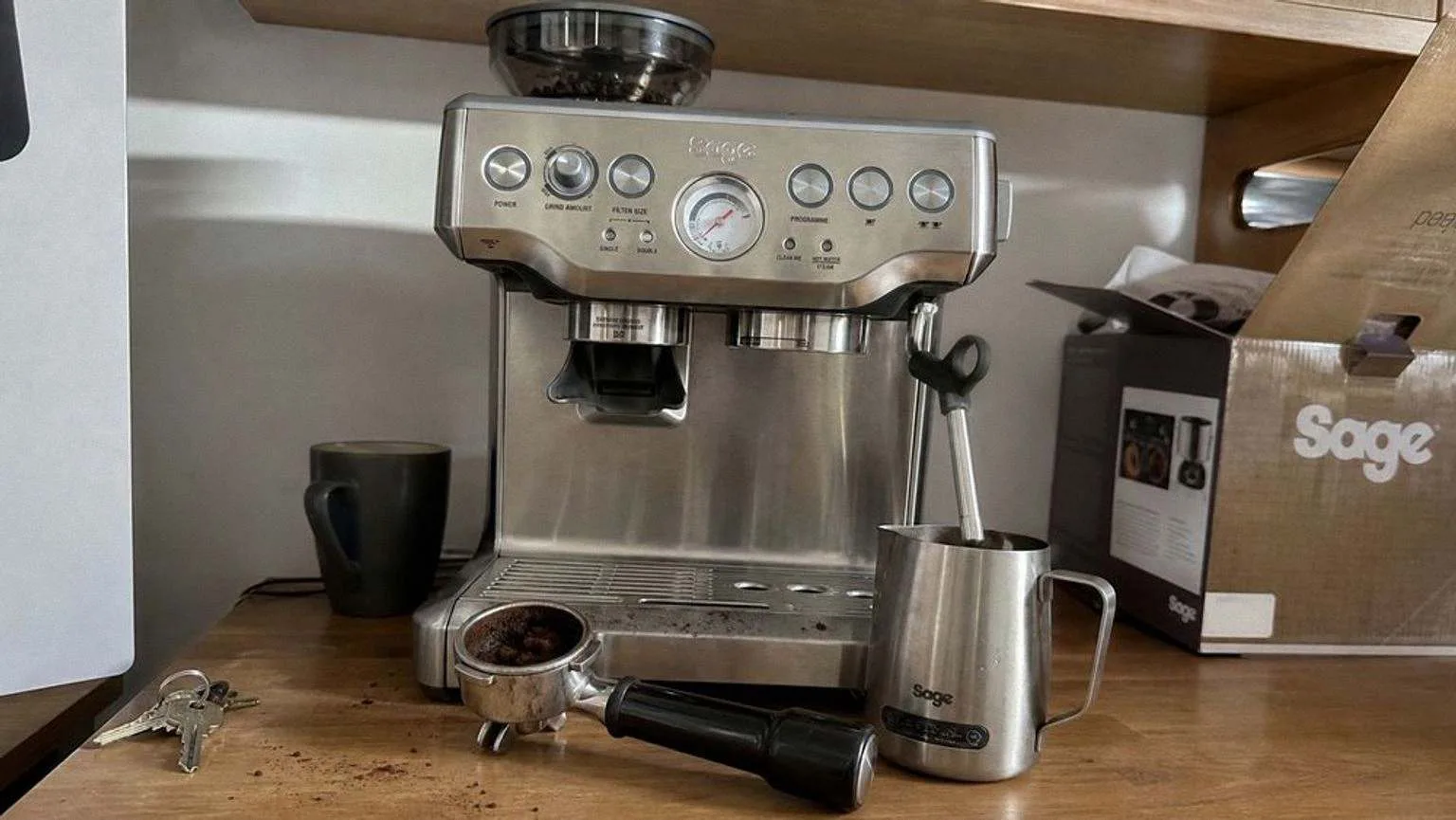
The specification is unusually complete for one appliance: a 15 bar pump, a thermocoil, and a conical burr grinder. Sage's manual for the BES875 lists a 2 litre removable tank and 1560 to 1850 watts, which is why it wants a socket to itself. The thermocoil is a single heating circuit that has to serve two jobs at two different temperatures, and that one design choice shapes half of this review.
The number that shapes ownership is the basket size. This is a 54 mm portafilter machine, Sage's own standard, and the accessory shelf around it is Sage's too. Bottomless portafilters, precision baskets and distribution tools all exist in 54 mm, though you are choosing from a smaller shelf than the person who bought a 58 mm machine. Our Gaggia Classic Evo Pro review covers what the commercial size buys instead.
The box arrives with both kinds of basket, and that pairing matters more than it sounds. Dual wall baskets pressurise the shot and forgive a bad grind. Single wall baskets forgive nothing, and they are the ones that make the machine worth owning.
Worktop reality: 40 cm tall, with a 0.9 m cord
Measure before you buy, because two dimensions catch people out. Sage's published figures put the machine at 40.4 cm tall, and the bean hopper sits on top of that, so a standard gap under a wall cupboard leaves you tilting it out to fill it. It is 31.8 cm wide and 35.1 cm deep. At 10.6 kg on the Currys spec sheet, it is heavy enough that you will not be sliding it about casually.
The mains lead is 0.9 m. That is short, and it decides which socket the machine can live near far more often than anyone expects.
A PID, a real wand and a burr grinder in one body, which is why it is the machine most people learn on. It is also messy to dose and makes you wait between brewing and steaming, and both are the price of the format.
- Build & durability
- Steam & milk
- Ease of use
- Value
- Versatility
Pulling a shot: 16 to 19 grams in, 25 to 35 seconds out
Sage prints the target in the instruction manual and it is worth taking literally: 16 to 19 grams for a double, tamped at 15 to 20 kg, running for 25 to 35 seconds. Past 40 seconds the manual calls the shot over-extracted, bitter and astringent. Under 20 seconds it is under-extracted and sour. Those two failure states are the whole of dialling in.
Where it frustrates people is the dose. The grinder runs for a set time rather than to a set weight, so the amount that lands in the basket is approximate. Sage ships a razor trimming tool to level the excess back off, which works, and which also tells you plainly what the dosing is. Expect grounds on the worktop for the first fortnight. Our ratio calculator will do the arithmetic for whichever basket you settle on.
Ease of use rates 3 with us, below the catalogue median of 4. It asks more of you than any bean-to-cup we track and considerably less than a machine with no readout at all.
Milk, and the wait between the two
Steam rates 4 out of 5 on the Barista Express, and the wand is a real one: a manual arm you angle into a jug, with none of the texturing done for you. It will make flat white milk. It will also make you learn how, and that bargain runs through every part of this machine.
Then there is the wait. That single thermocoil has to climb to steam temperature and come back down again, and the trip in each direction takes time you will spend standing at the worktop. Sage also caps continuous steaming at 5 minutes.
Two milk drinks on a Saturday and you will never think about it. Four in a row on a school morning and it becomes the reason people eventually trade up, because the queue forms behind the machine rather than behind the kettle.
The faults owners report, and which are not faults
Two of the most common complaints about this machine appear in Sage's own troubleshooting table as normal operation. Water pooling in the drip tray and apparent leaking after steaming are both listed under the auto purge feature: the machine deliberately dumps hot water to bring the thermocoil back down to brewing temperature, and the manual's instruction is simply to empty the tray more often. The machine is not failing. It is resetting itself and telling you so in the only way it can.
The real faults cluster in the grinder. Sage's manual names a blocked grind chamber or chute as the cause when no coffee reaches the basket, and moisture in the chute as the other culprit, which is what oily dark roasts produce and what happens if you wash the burrs and reassemble them damp. There is also a thermal cut-out: if the pump or the grinder overheats the machine stops, and the fix is to unplug it and wait 30 to 60 minutes.
For a sense of scale, Currys listed 4.8 out of 5 from 1,151 reviews on the BES875 in July 2026. An aggregate that high describes a machine people are glad they bought, and it tells you nothing about the distribution underneath it, which is where the disappointed end up.
Descaling it in a hard water house
Sage's own schedule sets 90 days between descales at water hardness level 4, and 60 days at level 6. The supplied water filter wants replacing after 3 months or 40 litres, and that 40 litre figure is itself pegged to level 4: in a soft area at level 2 you can stretch it to 60.
A household on a very hard supply is therefore signing up for six descales a year against four for a moderate one, and no retail listing anywhere mentions that running cost. It is the single biggest variable in how long the machine lives. The Drinking Water Inspectorate classes 200 to 300 mg per litre of calcium carbonate as hard, and above 300 as very hard, and the chalk under London and the South East puts a great many kitchens in that upper band.
When one of these machines dies young, limescale is almost always the reason.
What the Bambino Plus with a grinder does better
The cheaper Sage is not the worse machine on every axis, and the comparison is closer than the tier gap suggests. Our similarity model rates the Bambino Plus at 70 per cent of the Barista Express, yet it scores higher on both steam and ease of use. Read carefully, that 30 per cent gap is the grinder and the readout, and nothing else.
Where readers go instead
It heats in seconds, textures milk automatically, and out-steams the Barista Express outright. What it cannot do is grind, and a separate grinder good enough to feed it will cost about as much again. Our verdict on the smaller Sage sets out what that pairing asks of you.
Above both, the argument changes shape entirely. Machines like the Gaggia trade the grinder and the readout for a commercial group and a chassis built to be opened with hand tools, and they ask a great deal more of you every morning in return. Whether that trade pays depends almost entirely on how long you keep the machine.
Buy it if you want one box instead of two
Buy the Sage Barista Express BES875 if you want real espresso from whole beans without owning two appliances, and you accept that the grinder is competent where a dedicated one would be excellent. At 8.6 it makes the strongest all-in-one case in our catalogue, and the 2 year guarantee in Sage's manual is the standard cover rather than anything special. On the money itself the picture is less flattering, and where the value rating stops explains what the premium tier does not buy.
If that is you, the first thing to do with it is not make coffee. Weigh the dose and time the shot from day one, because those two numbers are the only part of this machine that is not a matter of taste.
Pros
- PID holds 93 degrees shot to shot
- Grinder and machine in one footprint
- Single and dual wall baskets both included
- Razor tool makes dosing repeatable
Cons
- Doses to a time, so nothing gets weighed
- Auto purge means a pause between coffee and milk
- 54 mm accessory shelf is smaller than 58 mm
- Grind chute clogs on oily dark roasts
Where to buy


Frequently asked questions about the Barista Express
Is the Sage Barista Express worth it?
Yes, with one condition, and it is not the money. Our top-scoring machine is also one that rates 3 out of 5 for ease of use, below the catalogue median of 4: it expects to be learned rather than to hand you coffee. Worth it if that is what you want, and if you would otherwise never have bought a grinder. Not worth it if you already own one, or if you want an appliance that asks nothing of you.
Why is Breville called Sage in the UK?
The machines are one product sold under two names in different territories. Sage is the brand across the UK and Europe; Breville is what the same range is called in the United States and Australia. It is why an American BES870 review describes a machine sold here under a different code, and why so many British buyers search for both names.
Is the BES875 the same as the SES875?
Yes. Sage issues a single instruction manual headed BES875/SES875, covering one machine. The suffixes track market and production variants rather than any change in what you get, and the UK retail code you will usually see is BES875UK.
Should I buy the Barista Express or the Barista Pro?
The Pro swaps the thermocoil for a faster heating system, which shortens both the warm-up and the brew-to-steam pause this review keeps returning to. If those delays are what worry you, the Pro answers them directly. If they do not, the Express does the same job on the coffee itself for less outlay.
How long will it last?
We rate build and durability 4 out of 5, and the limiting factor is almost never the shell. It is scale, so the answer depends on your postcode more than on the machine: kept to Sage's schedule for your own water hardness these are machines people keep for years, and off it they become a scale problem long before they become an old one. No expected lifespan is published anywhere we can source it, so treat any confident single figure as a guess.
What comes in the box?
More than most: a 54 mm portafilter, single and dual wall baskets in 1 and 2 cup sizes, an integrated tamper, a razor dose trimming tool, a stainless milk jug, a water filter and holder, and a cleaning kit with brush, disc, tablets and Allen key. The practical upshot is that you need beans and nothing else on day one.
Why is water collecting in the drip tray?
Because the machine put it there, on purpose. Sage's troubleshooting table files the auto purge under both "drip tray fills too quickly" and "water leaking", so a pool that appears after steaming is the design working rather than a fault. Two things separate that from a real leak: push the tray firmly home, because one sitting proud reads as a leak from the front, and note whether you steamed at all. Water arriving with no steam cycle behind it is worth a service call.
Will it fit under my wall cupboard?
It stands 40.4 cm tall, and you need clearance above that to lift the bean hopper lid and fill it. A typical worktop-to-wall-unit gap is around 45 to 50 cm, so it fits, though the filling will be tight. Measure your own gap before ordering, and remember the lead is only 0.9 m.
Sources we checked
Where to buy
Similar machines

Iona Brackley does the testing and the writing here: warm-up times from cold, brew temperature across three consecutive shots, milk in a small jug as well as a large one, and the noise a machine makes at seven in the morning. Where she has not had a machine in front of her, the article says so and stays with the specification and what owners consistently report.
Related articles
- GuideSage Barista Express worth it? Only if you own no grinder
It takes our highest score and only 4 of 5 for value. The distance between those two numbers is the whole answer, and a grinder sits inside it.
- ReviewSage Bambino Plus review: 8.4/10, and half a purchase
It scores 8.4 and out-steams machines from two tiers above it. The catch is the grinder it does not have, and a drip tray the auto purge keeps filling.
- GuideSage Barista Express alternatives: 4 cheaper ways in
Go cheaper and you hand back either the grinder or the portafilter. Only 1 of the 14 machines we track is a measured match for the BES875.
- ReviewLelit Anna PL41TEM review: is 57 mm worth a PID?
A factory PID at the entry to the prosumer tier, and a 57 mm group almost no third party kit fits. Which of those you notice depends on you.