
Cheaper alternatives to the Sage Barista Express


Go cheaper and you hand back either the grinder or the portafilter. Only 1 of the 14 machines we track is a measured match for the BES875.
Updated 2026-08-02: The Magnifica S now lists a water hardness setting, checked against De'Longhi's own manual: it is the only specification among the machines here that carries one, and that setting governs how often the machine asks to be descaled. We have also added an answer on how long these four last, and corrected the milk line in its section, where the Magnifica S ties with the Dedica at the bottom rather than sitting there alone.
VerdictThe Sage Barista Express BES875 is two purchases in one box, a machine and a grinder, and every cheaper route hands one of them back. We rate 4 worth owning. The Sage Bambino Plus is the closest at 70 per cent of it, and of the 5 machines we track that grind their own beans, only 2 cost less.
Barista Express BES875
Bambino Plus
Which one to buy?
- Best for: The closest matchFull review →
The one machine our model puts a number on, at 70 per cent, and it steams better than the original.
See the breakdown ↓ - Best for: If the grinder was the point
De'Longhi Magnifica S ECAM22.110
Full review →Grinds its own beans and takes the brew group out for cleaning, at the cost of the milk.
See the breakdown ↓ - Best for: If the worktop decides
Fifteen centimetres wide, and still a real portafilter machine.
See the breakdown ↓ - Best for: Grinder kept, milk kept
The other bean-to-cup route, scoring 4 for steam where the Magnifica S scores 2.
See the breakdown ↓
In this article
- What is the alternative to the Sage Barista Express?
- The Sage Bambino Plus is the closest thing to it
- Keeping the grinder: the De'Longhi Magnifica S ECAM22.110
- When the worktop decides: the De'Longhi Dedica Style EC685
- The Philips Series 3200 LatteGo takes the same route and keeps the milk
- Where the cheaper machines fall short
- What we left out, and why
- Frequently asked questions about going cheaper
Most people who shop below the Barista Express end up spending more than they meant to.
That is what happens when the cheap machine comes first and the grinder second, in that order, and it is avoidable. Four machines in our catalogue are worth buying instead of the BES875, and only the Sage Bambino Plus sits close enough that our model puts a figure on the gap: 70 per cent. That assumes the BES875 is the right target, and what its premium actually buys comes first.
The other three are not smaller Barista Expresses. They are different bargains, and the one that looks cheapest is the one you will resent by roughly the second week.
What is the alternative to the Sage Barista Express?
Four machines, and choosing between them turns on one question: the grinder, or the portafilter? Of the 14 machines in our catalogue, five grind their own beans, and only two of those cost less than the BES875. Both are sealed bean-to-cup machines that never hand you a portafilter, the handled basket you fill with coffee and lock into the machine.
So nothing cheaper keeps both halves. That is the entire shape of this decision, and every recommendation below is a way of choosing which half to give up.
One cheaper machine in our catalogue carries a measured match to the BES875, which is why the table below has a single row rather than four. A percentage we cannot document is a percentage we will not print.
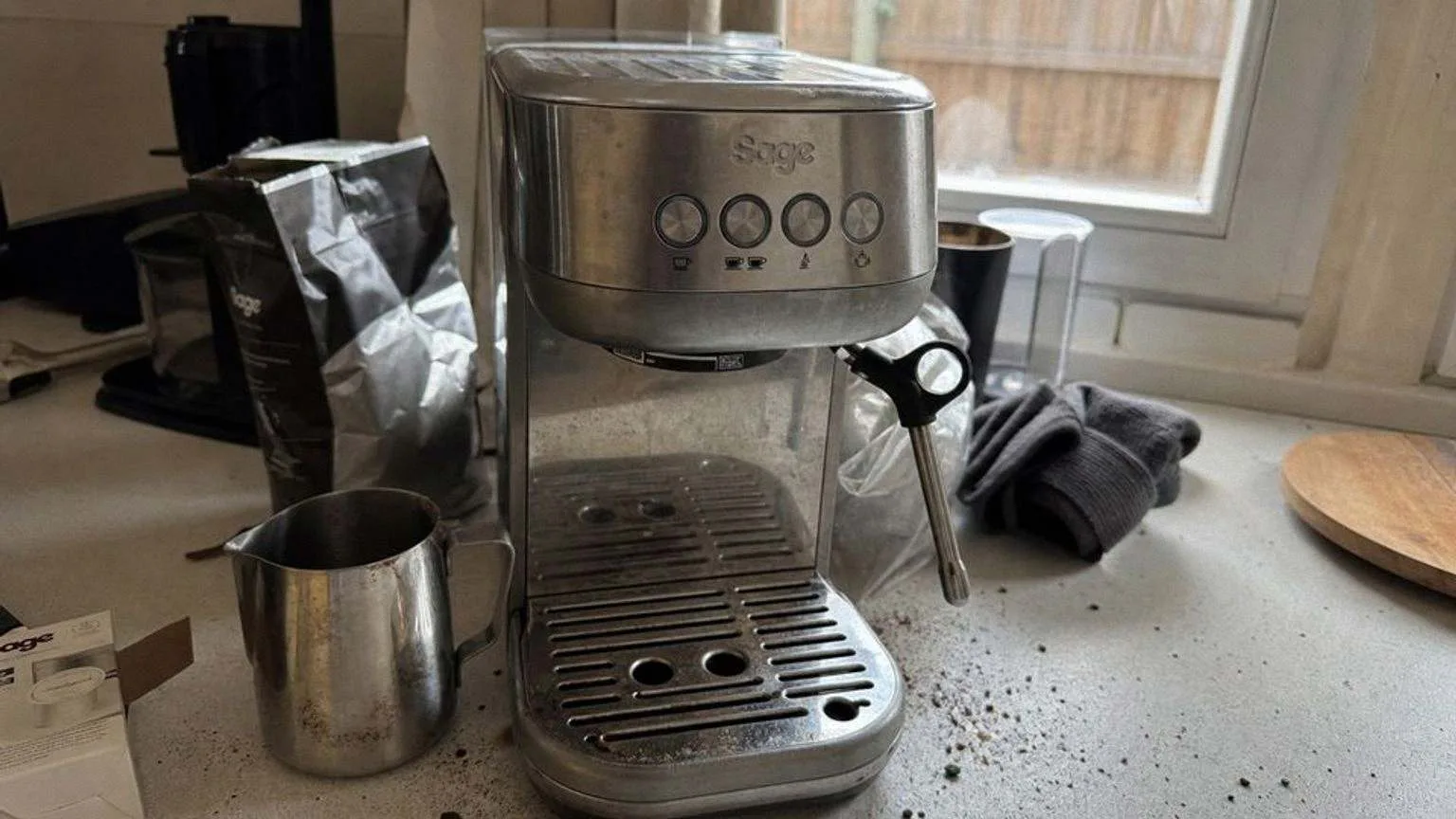
- SageBambino PlusFull review →
What you give up: No grinder and no PID readout: you dial in by taste rather than by number, and the grinder becomes a separate purchase that costs as much again.
How close70%
A cheaper machine gets you most of the result, not all of it — usually the last of the temperature stability or the milk. Price is confirmed at the store.
The Sage Bambino Plus is the closest thing to it
At 70 per cent of the Barista Express on our similarity model, this is the only cheaper machine with a number attached, and it beats the dearer one where you touch it daily: 5 for steam against 4, and 4 for ease of use against 3. Our review of the BES875 works through what the remaining gap holds.
Buy the Bambino Plus if a grinder was always going to be a separate purchase anyway.
The shot-making kit survives the price cut almost intact. Sage's specification gives it the same 54 mm portafilter, an 18 gram dose target, dual wall and single wall baskets in the box, and the razor tool for trimming a dose level. Sage also quotes its ThermoJet heater at 3 seconds from cold, with an automatic wand offering three milk temperatures and three texture levels, and that wand is why this machine out-steams the one above it.
Then the hopper is missing, and everything follows from that. You dial in by taste, meaning you adjust the grind and the dose until the shot stops tasting sour or bitter, because there is no readout telling you what changed. Feed it supermarket pre-ground to dodge the extra outlay and you have bought a worse machine than the one you were avoiding.
The grinder that makes this pairing work is a second purchase of similar weight. Count both, or the saving is imaginary, and our ratio calculator will handle the dose arithmetic once you have them.
On a weekday it reads well. It is ready before the kettle, and the milk is done by the time you have found a cup. What owners say after three months is the other half of that picture, drip tray included.
Keeping the grinder: the De'Longhi Magnifica S ECAM22.110
Fifteen years on sale and still the machine a great many British kitchens end up with. It scores 7.8, it grinds on conical steel burrs, and the brew group, the assembly that actually packs and wets the coffee, slides out under a tap. That last detail decides year five. The catch is milk, where it rates 2, level with the Dedica at the bottom of these four picks.
Buy the Magnifica S if the grinder was the appeal and the portafilter never was.
You order espresso from this machine more than you make it. Nothing to fill, nothing to tamp, nothing to weigh. That removes the whole apprenticeship, and it removes the ceiling with it, permanently rather than for now.
Our record notes one quirk worth knowing before you buy: the two finest grind settings jam it. Stay a click coarser. The full review works through that dial and the water setting that decides how long the machine lasts.
A water hardness setting turns up on exactly one specification in this catalogue of 14, and this is the machine. The manual holds the mechanism: a test strip in the box, a level you dip for and key in, and a descale countdown that then runs on your supply instead of a factory assumption. In a hard water area that is about a minute of setup buying you years.
When the worktop decides: the De'Longhi Dedica Style EC685
Fifteen centimetres wide. That is the argument, and in a galley kitchen it is the only one that counts. The Dedica Style EC685 scores 7.0 and is the cheapest of these four picks that still puts a portafilter in your hand, though it arrives with a pressurised basket and a panarello frother, a sleeve that draws air into the milk automatically, and those two parts set its ceiling.
Buy the Dedica if the gap on your worktop is narrower than 20 cm and the coffee has to fit it.
A pressurised basket pushes the coffee through one small hole, so it produces crema, the caramel foam on top of a shot, out of almost anything. Even a supermarket bag opened last spring. That is a kindness while you are learning and a wall the day you stop.
The frother is the harder limit. It aerates the milk without texturing it, so the foam sits on the surface of the cup and stays there, and this is the machine that will not make you a flat white. That is the resentment the intro promised, and it arrives every morning you wanted one.
Our catalogue puts the Dedica at 55 per cent of the Bambino Plus. Read the two steps down together and the shape is plain: the first costs you a grinder, the second costs you the milk. Going below the Bambino Plus is where that second bill comes due.
The Philips Series 3200 LatteGo takes the same route and keeps the milk
Most people drawn to a bean-to-cup should take this version of it. The Series 3200 LatteGo scores 7.9 and grinds its own beans too, on flat ceramic burrs where the De'Longhi uses conical steel, and it rates 4 for steam where the Magnifica S rates 2. Same format, same tier, two points apart on the axis a milk drinker uses every morning.
Buy the Series 3200 if you want the machine to do everything and you drink flat whites.
The milk system explains the gap. LatteGo is two parts with no tubes anywhere in it, and it comes off and rinses under a tap in seconds. Milk systems fail because nobody cleans them, and the ones that get cleaned are the ones that are quick to clean.
One warning for anyone reading American coverage: the code sold here is the EP3241/50, and the /50 has no iced coffee function, whatever a review of a /54 says.
| SageBarista Express BES875Full review → | SageBambino PlusFull review → | De'LonghiMagnifica S ECAM22.110Full review → | PhilipsSeries 3200 LatteGo | De'LonghiDedica Style EC685 | |
|---|---|---|---|---|---|
| Score | 8.6 | 8.4 | 7.8 | 7.9 | 7.0 |
| Build & durability | 4/5 | 4/5 | 4/5 | 4/5 | 3/5 |
| Steam & milk | 4/5 | 5/5 | 2/5 | 4/5 | 2/5 |
| Value | 4/5 | 4/5 | 5/5 | 4/5 | 4/5 |
| Versatility | 4/5 | 4/5 | 4/5 | 4/5 | 3/5 |
| Format | Espresso (portafilter) | Espresso (portafilter) | Bean-to-cup | Bean-to-cup | Espresso (portafilter) |
| Main strengths | Espresso quality | Speed | Easy cleaning | Easy cleaning | Compact footprint |
| Suits which household | Two people, Family | One person, Two people | Two people, Family | Two people, Family, Office | One person, Two people |
| Suits | Enthusiasts | Beginners | Beginners | Beginners | Beginners |
| Check price |
Where the cheaper machines fall short
Temperature is the loss nobody notices on day one. The BES875 is the only machine in our data carrying a PID, a controller that keeps brew water at a set temperature, alongside a burr grinder. Without one, a plain thermostat drifts either side of the target, and the third cup of a morning stops tasting like the first. How we score these machines explains where that number comes from.
The second loss is the upgrade path, and it only bites later. A 54 mm Sage machine sits inside an accessory shelf you can keep buying from, with baskets, tampers and distribution tools made to fit. A sealed bean-to-cup sits inside nothing, and when its brew group finally wears you are shopping for a whole machine. The Gaggia Classic Evo Pro is the other end of that argument: spend the money on the group and the chassis, and every morning asks more of you.
A thread on a UK coffee forum, opened by an owner replacing a Barista Express after 15 years, puts the trade in one line: leave Sage and the thing you give up is the automated milk steaming, with a bigger steam boiler arriving in its place.
What we left out, and why
Four cheaper machines in our catalogue never made the list, and the reasons are quick. Two of them make no espresso at all, one makes it only from a pod, and the fourth asks for too much compromise to save a single step down.
- Moccamaster KBG Select: excellent at filter coffee and scoring 8.2, the best score among these four near misses. It has no pump, so it has nothing to do with this decision.
- Stilosa EC230: a real portafilter machine and cheaper than the Dedica, rating 2 for build and 2 for milk. A lot to give up for one step.
- Bialetti Moka Express: a fine cup of coffee and no espresso, again because there is no pump anywhere in it.
- Nespresso Vertuo Pop: solves a different problem. Fast, consistent, and it never lets you choose a bean.
Frequently asked questions about going cheaper
What is the best cheaper Sage machine?
The Bambino Plus, comfortably. It is the only other Sage espresso machine we track, it scores 8.4, and it keeps the 54 mm portafilter, both basket types and the razor tool.
Do you need a separate grinder for the Bambino Plus?
Yes, and it belongs in the same decision rather than a later one. There is no grinder in the machine at all, and pre-ground supermarket coffee wastes most of what you paid for, since ground coffee goes flat within days of opening. Budget for a burr grinder alongside it and the two together land near the machine you were avoiding. If that total is uncomfortable, the honest answer is that the all-in-one was the cheaper path from the start.
Is a bean-to-cup machine a real alternative to the Barista Express?
It replaces owning one, not using one. A bean-to-cup grinds, doses, tamps and brews behind a closed door, so the coffee is consistent and none of it is yours to change. If the grinder was the appeal, the swap works well. If the portafilter was, you will feel it inside a fortnight.
Which of these will make a flat white?
The Bambino Plus does it best and rates 5 for steam, its wand texturing the milk without your help. The Series 3200 manages a decent one through its milk carafe. The Magnifica S and the Dedica both rate 2 and produce foam sitting on top of the cup.
Is De'Longhi espresso better than Sage?
Not on our scores, though the fair comparison is narrower than the question. Set espresso machine against espresso machine and Sage leads: 8.6 and 8.4, against the La Specialista Arte at 7.9, the Dedica at 7.0 and the Stilosa at 6.8. The La Specialista Arte is the closest De'Longhi gets and our catalogue marks it superseded, so stock is whatever remains. Where De'Longhi genuinely wins is the bean-to-cup format, which Sage does not field here.
Do cheaper coffee machines cost less to run?
Only slightly, and not where people expect. Beans dominate the running cost on all four picks, and three of them want a water filter and a descaling programme on a similar schedule. The Dedica is the exception, with no water filter in its specification, so that is one consumable fewer to buy and one more reason to keep to the descaling schedule. Pod machines run the other way entirely: cheap to buy, dearer per cup, for as long as you own one.
How long do barista coffee machines last?
Nobody publishes a figure, and any single number is a guess. Our scores narrow it: three of these four picks rate 4 out of 5 for build and durability, and the Dedica rates 3. Limescale ends far more of these than wear does, so the real variable is what comes out of your tap and how often you act on it. If a long ownership is the whole point, a machine built to be opened argues a different case entirely.
Do coffee machines get cheaper at any point in the year?
They move about, most of all from November into the January sales, when discounting on this category is heaviest. We do not print prices, because they change faster than any article can follow, and the store page is the only honest place to read one. Worth knowing: model codes churn at the same time of year, so an unusually cheap machine is sometimes last season's code rather than a genuine cut.


Sources we checked
Similar machines

Iona Brackley does the testing and the writing here: warm-up times from cold, brew temperature across three consecutive shots, milk in a small jug as well as a large one, and the noise a machine makes at seven in the morning. Where she has not had a machine in front of her, the article says so and stays with the specification and what owners consistently report.
Related articles
- GuideSage Barista Express worth it? Only if you own no grinder
It takes our highest score and only 4 of 5 for value. The distance between those two numbers is the whole answer, and a grinder sits inside it.
- ReviewSage Bambino Plus review: 8.4/10, and half a purchase
It scores 8.4 and out-steams machines from two tiers above it. The catch is the grinder it does not have, and a drip tray the auto purge keeps filling.
- ReviewSage Barista Express BES875: worth it at 8.6/10?
One body that grinds, doses and brews, and the 8.6 that comes with it. The costs are a dose measured in seconds and a pause every time you steam.
- ReviewLelit Anna PL41TEM review: is 57 mm worth a PID?
A factory PID at the entry to the prosumer tier, and a 57 mm group almost no third party kit fits. Which of those you notice depends on you.