
De'Longhi Magnifica S ECAM22.110 review


The only one of our 14 machines at the top mark for both value and ease of use, at a score of 7.8. Then you meet the milk wand, and the case narrows sharply.
VerdictThe De'Longhi Magnifica S ECAM22.110 scores 7.8 on our ten point scale and is the only one of the 14 machines we track to take the top mark of 5 for value and for ease of use at once. It pays for that with milk: steam rates 2, the joint lowest of anything here that steams at all.
Key facts
Mid-range: where most households land, and where the gap between models is widest.
In this article
- Is the De'Longhi Magnifica S worth buying?
- The two grind settings you paid for and cannot use
- Conical burrs, a thermoblock and a good deal of plastic
- Milk is the thing it was never built to do
- Magnifica S or Philips Series 3200 LatteGo?
- Where owners split on the plastic
- Your postcode decides whether it reaches year ten
- A weekday morning with it
- What it gives up to the machines above it
- The verdict on the Magnifica S
- FAQ: setting it up and living with it
The Magnifica S has been on sale for 15 years, which for a kitchen appliance is close to geological.
It has outlasted several of the nameplates De'Longhi launched above it, and it is still the machine we would put in most British kitchens. It managed that by being unglamorous in exactly the right places. Beans go in the top. Coffee comes out of the front. Nothing asks you to learn anything.
There is a bill for that, and it arrives in two instalments. You meet the first one on the grinder dial in about week one. The second turns up around year ten, and it has more to do with your postcode than with anything the factory did.
Is the De'Longhi Magnifica S worth buying?
Yes, if the coffee you actually drink is black. Our score of 7.8 puts it 10th of the 14 machines we rate, which sounds unremarkable until you look at which two ratings carry it: value and ease of use both come out at the ceiling of 5, and no other machine in this catalogue manages that pair. The ranking measures the coffee. Those two measure the mornings.
Milk on this machine is a manual sleeve you hold a jug under, not a button you press.
If a cappuccino is the drink that matters in your house, the Philips Series 3200 and its two-part milk system answers that question properly for similar outlay, and we would send you there without much hesitation.
The two grind settings you paid for and cannot use
De'Longhi fits a conical burr grinder with 13 settings. Arne Preuss at Coffeeness, reviewing this exact model, reports that the two finest of them jam the grinder, which he describes as getting overwhelmed, and settles on setting 3 as the one to use. Take him at his word and the usable range is 11.
A second published fact explains the first, and the two rarely appear side by side. De'Longhi's own instruction is that the dial may only be moved while the grinder is running, one notch at a time, and that it may take a few coffees before the change shows up in the cup.
Read those together and the jam stops being a fault and starts being a sequence. Somebody turns a stiff dial on a silent machine, because that is what dials are for. The burrs end up set finer than they were ever asked to clear, and the next shot arrives to find the chamber packed solid.
So: grind while it grinds, one click, then wait three coffees before you judge. The people who lose a fortnight to this are following an ordinary instinct.
Our model rates grinding at 55 here, the lowest of the three machines in this catalogue we score for it at all, and that is the honest read of what a grinder built into a machine this size can do. It gives you beans ground seconds before the water hits them, at a fineness you steer instead of choose. The ratio calculator will do the dose sums; the dial does the rest.
Conical burrs, a thermoblock and a good deal of plastic
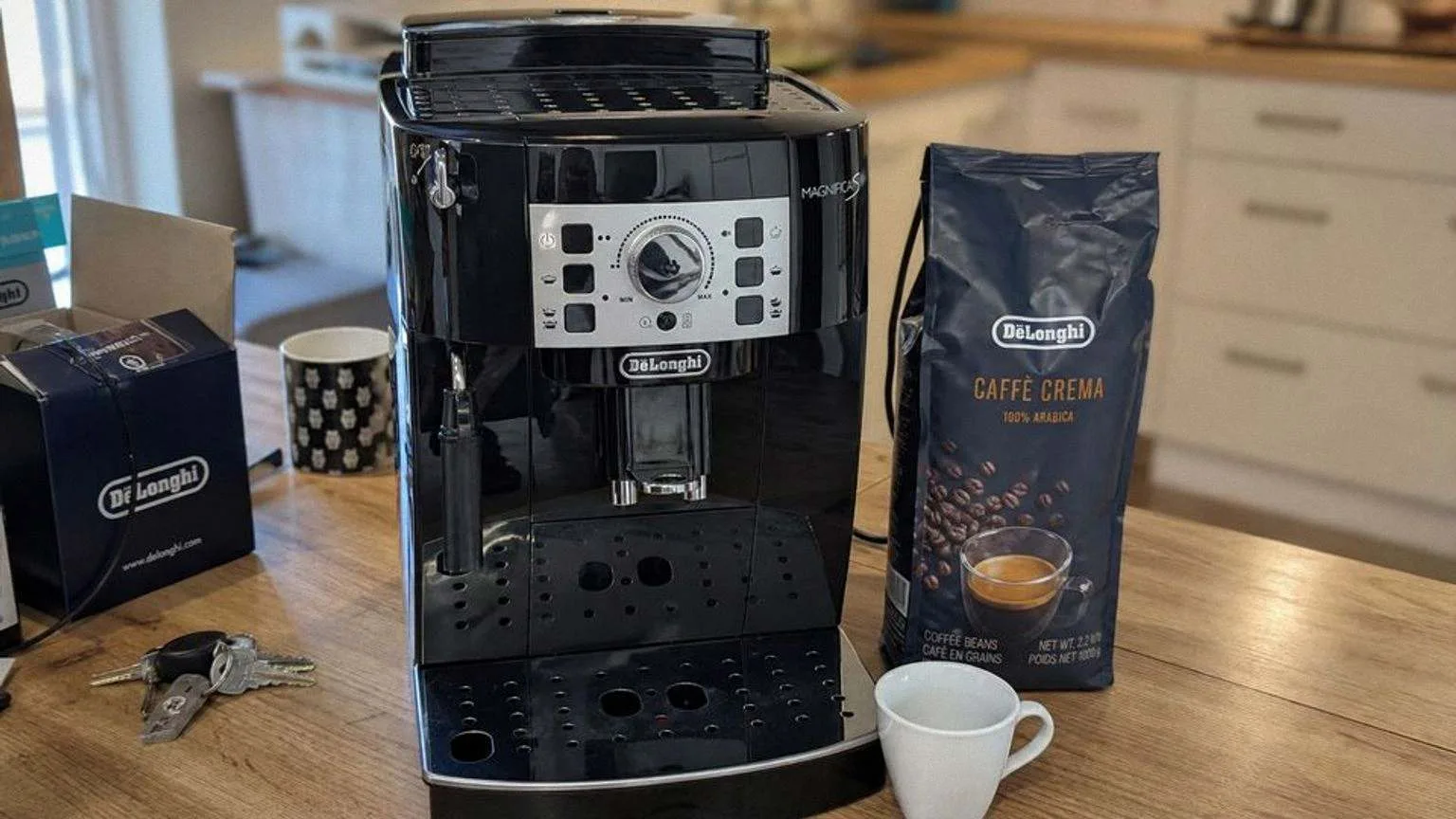
The specification is deliberately unexciting. A 15 bar pump, steel conical burrs, a 1.8 litre tank that lifts out for filling, and a thermoblock in place of a boiler, which means it heats water on the way past instead of keeping a tankful hot. Coffeeness notes that the housing is plastic throughout, and it is.
One component matters more than the rest. The removable brew group lifts out, goes under a tap, and goes back. Machines that seal that assembly inside the body get descaled and hoped over; this one gets cleaned.
Fifteen years on sale and still the bean-to-cup most British households end up with. The brew group comes out for cleaning, which is the feature that decides year five, and the two finest grind settings jam it.
- Build & durability
- Steam & milk
- Ease of use
- Value
- Versatility
The manual asks for that group to be cleaned at least once a month, and for the pre-ground funnel to be checked on the same schedule. Neither job takes long, and together they are why build and durability rate 4 here instead of 2.
Milk is the thing it was never built to do
Steam and milk score a 2 here, and only the Stilosa and the Dedica sit that low among the 11 machines in this catalogue that steam anything at all. Both of those are cheaper machines that do less in every other respect, which tells you where De'Longhi spent the money. Coffeeness puts it plainly, saying the steam pressure is nowhere near what a decent home espresso machine gives you.
The part fitted is a panarello wand, a sleeved frother that pulls in air through a hole in the side and blows bubbles into the milk. It makes foam. What it will not make is the tight, glossy milk that folds into a cup in one unbroken pour, and no amount of practice gets it there, because the sleeve has taken that job away from you and does it the same way every time.
For a cappuccino under a cap of froth, that is enough, and always has been. For a flat white it is not, and pretending otherwise is how people end up disappointed by a machine that is behaving exactly to specification.
Worth knowing before you decide: of the three bean-to-cup machines we track, this is the only one that hands you a wand at all. The other two automate the milk and let you press a button.
Magnifica S or Philips Series 3200 LatteGo?
These two are the real cross-shop, and our scores put them a tenth apart at 7.8 and 7.9, which is a tie. Deciding on decimals would be silly. Decide on milk, because that is where they genuinely diverge: the Philips rates 4 for steam against this machine's 2, and its LatteGo carafe is two parts with no tubes that rinse under a tap in seconds.
Against that, the Magnifica S takes our top value mark where the Philips takes 4.
So it is a fork, not a winner. Black coffee and a low outlay point here. Milk drinks at the touch of a button point at the Philips, and it is not close.
Where owners split on the plastic
Two camps look at the same plastic body on the Magnifica S and reach opposite conclusions, and the argument is not about whether it lasts. Both sides agree it does. They disagree about whether a machine you will touch twice a day for a decade is allowed to feel like this, which is a question about you.
Our own view leans to the first camp. Plastic that carries no heat is a reasonable place to save money, and the components under stress here are not the ones your hands ever touch.
Your postcode decides whether it reaches year ten
Limescale ends these machines long before anything mechanical wears out, and in Britain that makes longevity a geography question. De'Longhi ships a test strip: dip it, count the red squares, and set the machine to the number you get. The manual puts the factory default at 4, the hardest setting, which is the safe assumption and the wrong one if your water is soft.
Get the water hardness setting right and the machine counts down to a descale on a schedule that suits your supply. That is the whole job of the setting: the manual has you program the level once, and the machine does the counting from then on. A hard water household will meet that prompt several times more often than a soft water one. Across the chalk belt of London and the South East, assume the short end.
That is two minutes of setup on the day it arrives, almost nobody does it, and it is the single highest-leverage thing you can do to this machine.
A weekday morning with it
Ease of use takes the top mark of 5, and the reason is that nothing about the machine asks you to plan ahead. Beans in the hopper, water in the tank, press a button. There is no warm-up worth thinking about, no basket to dose, tamp or level, and no decision to make before coffee exists.
What you do instead is empty things. The grounds container fills with pucks, the drip tray fills with rinse water, and the machine flushes itself at switch-on and switch-off. That automatic cleaning is a feature. It is also a small daily tax.
The interface is buttons and a dial. There is no display screen on this model, whatever a listing photo of a pricier Magnifica suggests, so what each control does is something you learn from the manual rather than read off a screen. Out of the box an espresso pours roughly 40 ml and a long coffee 120 ml, both adjustable by holding the button down, and the dial marked with beans sets how much coffee goes into that water. Programme those two and you stop looking at the machine altogether.
What it gives up to the machines above it
Only 4 of our 14 machines take the top value mark, and the Magnifica S is the one bean-to-cup among them. That is the clearest statement of what it is: the cheapest route in this catalogue to beans ground fresh at the moment you press a button. What the machines above it charge for is either milk you do not have to think about or espresso you make yourself, and the second of those is the trade worth spelling out.
The machines it gets weighed against
Step sideways instead of up and the Sage Bambino Plus scores 8.4 and takes the top steam mark, but it grinds nothing and needs a burr grinder standing beside it. Two appliances and a skill, against one box and a button. That is the whole trade in a sentence, and which side of it you want is mostly a question of how much you enjoy the process.
The verdict on the Magnifica S
Buy the Magnifica S if you drink black coffee on weekday mornings and want it ground fresh without learning anything. That reader is very well served at 7.8, and has been for fifteen years. If that is you, stop comparing: the machines above it in our ranking are charging for milk or for craft, and you want neither.
Buy it also if a pod machine is what you are replacing and the recurring cost is what pushed you out. Beans in a hopper settle that arithmetic immediately, and the button is the same button.
Do not buy it as a milk machine that also makes espresso. It is an espresso machine that also makes milk, badly, and every disappointed owner we can find in the published reports got those two the wrong way round.
Pros
- Fresh ground coffee at the touch of one button
- Brew group lifts out for proper cleaning
- 1.8 litre tank and a 15 bar pump
- Top marks from us for value and ease of use
Cons
- Panarello frother will not texture milk properly
- Two of the 13 grind settings jam the burrs
- Plastic housing throughout
- Grounds container and drip tray need emptying often
Where to buy


FAQ: setting it up and living with it
What is the difference between the ECAM22.110.B and the ECAM22.110.SB?
The finish. De'Longhi lists the B as the black model and the SB as silver and black, and both are the same Magnifica S underneath. Buy whichever suits the kitchen or whichever is cheaper on the day you look.
Which grind setting should I use?
Start at 3, which is where Arne Preuss at Coffeeness lands for this machine after finding the finest settings unusable. Move one notch at a time and only while the grinder is actually turning, then give it a few coffees before judging the result. Thin and fast in the cup means go finer. Dripping and harsh means go coarser.
How long does a De'Longhi Magnifica S last?
No manufacturer commits to a figure, so distrust anyone who quotes one. We rate build at 4, and what decides the outcome is limescale rather than the mechanism: RedditRecs, which indexes owner reports from Reddit, lists two accounts of older Magnifica machines still working at eight and ten years. Set the hardness level correctly, descale when it asks, rinse the brew group monthly. Machines that die young in Britain are nearly always killed by their water.
Can you use pre-ground coffee in it?
Yes. The manual gives it a separate funnel and a measuring scoop, with a button that tells the machine to skip the grinder for that cup. It is the sensible way to make one decaf in the evening without emptying the hopper of your usual beans. Check the funnel for blockages monthly.
Can it make a flat white?
Not properly. That drink needs milk textured smooth and fine, and the panarello sleeve makes something airier by design. You will get a perfectly drinkable milky coffee. You will not get the pour, and practice will not close the gap, which is the honest reason steam and milk sit at 2 on our scale.
How often does it need descaling?
That depends on your water, which is why the test strip is in the box. Rather than work to a calendar, the machine tracks the interval itself once the hardness level is set, and tells you when it is due. Since the factory default is the hardest setting, a soft water household that never changes it will be descaling far more often than necessary.
Is it noisy?
No independent decibel figure exists for this model, which is worth saying rather than inventing one. The grinder is the loud part and it runs for a few seconds; the pump is quieter than a kettle reaching the boil. UK reviewers comparing it with the older ESAM4200 it replaced describe the newer grinder as noticeably quieter, which is a relative claim and not a measurement.
Sources we checked
- delonghi.com/en/p/magnifica-s-ecam22.110.b-magnifica-s-au…
- delonghi.com/en-us/faqs/How-do-I-adjust-the-coffee-grinde…
- coffeeness.de/en/delonghi-ecam-22-110-review
- manualslib.com/manual/840015/D-Longhi-Ecam22-110.html
- redditrecs.com/espresso-machine/model/delonghi-magnifica-s-…
- dailyespresso.co.uk/delonghi-ecam-22110b-review
Where to buy
Similar machines

Iona Brackley does the testing and the writing here: warm-up times from cold, brew temperature across three consecutive shots, milk in a small jug as well as a large one, and the noise a machine makes at seven in the morning. Where she has not had a machine in front of her, the article says so and stays with the specification and what owners consistently report.
Related articles
- GuideGaggia Classic Evo Pro: is it worth it? 8.5, plus a grinder
It scores 8.5 and takes our top value rating, the only machine above the mid tier that does both. The grinder is the part nobody budgets for.
- GuideSage Barista Express alternatives: 4 cheaper ways in
Go cheaper and you hand back either the grinder or the portafilter. Only 1 of the 14 machines we track is a measured match for the BES875.
- ReviewLelit Anna PL41TEM review: is 57 mm worth a PID?
A factory PID at the entry to the prosumer tier, and a 57 mm group almost no third party kit fits. Which of those you notice depends on you.
- GuideSage Barista Express worth it? Only if you own no grinder
It takes our highest score and only 4 of 5 for value. The distance between those two numbers is the whole answer, and a grinder sits inside it.